


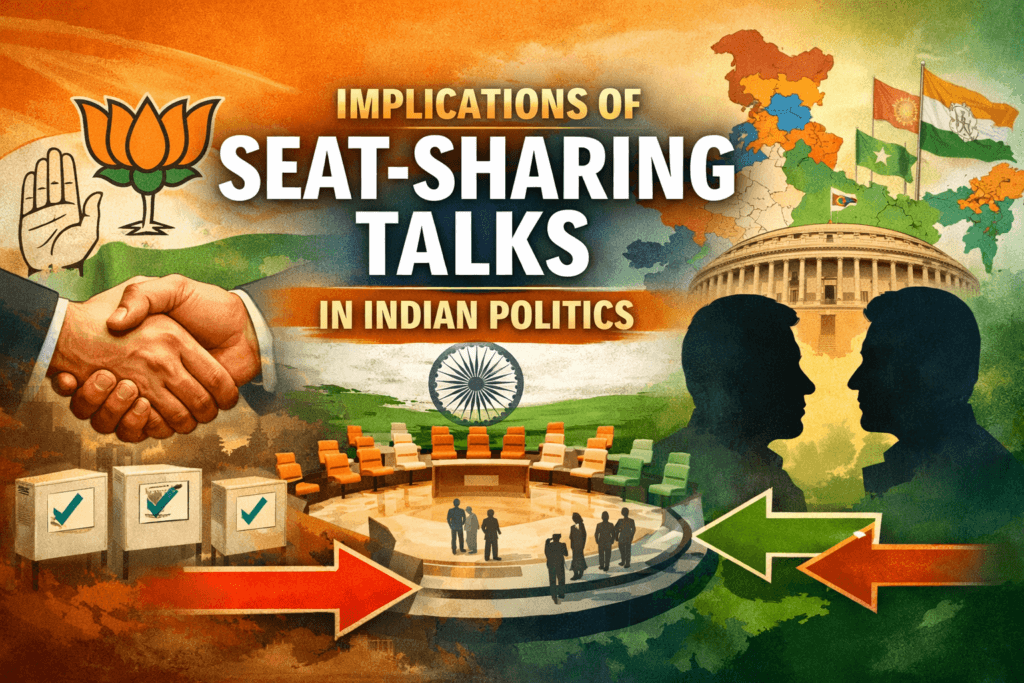
Implications of Seat Sharing Talks in Indian Politics Ahead of National Elections
Implications of Seat Sharing Talks in Indian Politics
Ahead of National Elections
Seat Sharing Talks in Indian Politics, negotiations have once again gained prominence as parties get ready for the next state and national elections. Seat-sharing arrangements are strategic choices that influence government, public opinion, and the direction of coalition politics, regardless of whether they are made between regional or national giants.
Both the opposition groupings like the Indian National Congress and the ruling alliance, led by the Bharatiya Janata Party (BJP), are involved in intricate negotiations with regional allies as the race to the next legislative election heats up.
These discussions are a reflection of more general changes in grassroots calculations, ideological stances, and political math. This article investigates the more profound effects of seat-sharing agreements on Indian politics, looking at how they affect voting patterns, governance models, inter-party interactions, and election results.
Top Women Cricketers Who Changed the Game


Strategically Seat Sharing in India
The basic idea of seat-sharing is to maximize winnability while minimizing vote divides. Even slight differences in votes can significantly change the outcome in India’s first-past-the-post electoral system. Therefore, the purpose of alliances is to unite votes across linguistic, religious, caste, and regional divides. For example, alliance arithmetic has historically been crucial in states like Bihar and Maharashtra.
To avoid the division of pro-incumbency or anti-incumbency votes, the Indian National Developmental Inclusive Alliance (INDIA bloc) and the National Democratic Alliance (NDA) are adjusting their seat distribution formulas. The dominant party within an alliance is frequently exposed through seat-sharing agreements. The distribution of seats takes into account public perception, negotiating leverage, and power dynamics in addition to being a practical consideration.
Alliance Power Equations
The distribution of seats acts as a gauge of political power. While smaller allocations could suggest a compromised or dependent posture, a party with a bigger percentage of seats indicates supremacy. The Dravida Munnetra Kazhagam (DMK) has a strong regional base and has historically led alliance negotiations in states like Tamil Nadu.
Similarly, there is no opportunity for equitable negotiation by national parties in West Bengal, where the All India Trinamool Congress (TMC) continues to be the dominant force. Such agreements frequently lead to conflict. While larger parties want to maximize seats without upsetting friends, smaller parties seek significance and bargaining power. As demonstrated by previous alliance failures in states like Maharashtra, breakups can change political environments if discussions fail.
Hospitality Sector CSR Projects 2026


Effects on Regional vs. National Parties
The shifting balance between national and regional forces is highlighted by seat-sharing discussions. Regional parties have localized power based on identity politics and state-specific issues, whereas national parties offer ideological narratives and wider appeal. Strong caste-based vote banks are controlled by regional players such as the Rashtriya Janata Dal (RJD) and the Samajwadi Party (SP).
Any alliance that doesn’t include these parties runs the danger of losing important parts. In seat-sharing discussions, national parties—particularly the Congress—must strike a balance between demonstrating leadership and recognizing local advantages. Overestimating one’s influence can have negative effects, and making too many concessions can impede the long-term development of an organization.
Effect on the Behavior of Voters
Voter psychology is also shaped by seat-sharing arrangements. Alliances that seem stable and cohesive convey cohesion and a clear sense of purpose. On the other hand, protracted talks and public disputes may indicate instability. Decisions on seat sharing are frequently interpreted by voters as signs of ideological compatibility.
Alliances between parties that have historically been at odds, for instance, could perplex long-time supporters. If ideological inconsistencies become too obvious, voters may become less enthusiastic.
Community and Caste Calculations
It is impossible to divorce caste and community factors from India’s electoral politics. A common topic of discussion in seat-sharing discussions is demographic math. Caste coalitions play a key role in discussions in Uttar Pradesh and Bihar. Parties use the existence of dominating castes in constituencies to determine where to deploy candidates. A poor decision may lead to discontent among grassroots activists or insurrection inside the party.
Combining complementary caste bases might result in significant electoral benefits, as seen by the success of prior alliances. However, if representation seems uneven, it also runs the danger of alienating minority groups.
Seat Sharing Dynamics
Regarding alliance negotiations, Maharashtra continues to be one of the most complicated states. Parties have been forced to reconsider their seat-sharing arrangements as a result of political realignments that have altered longstanding alliances.
Problems with Internal Parties
Internal discontent is frequently triggered by seat sharing. Party members who are refused tickets because of alliance obligations may defect or run on their own. Alliance arithmetic may be weakened by this uprising. It becomes essential to control morale at the grassroots level. Leadership needs to strike a balance between cadre aspirations and alliance commitments. Dissatisfaction is frequently reduced by open communication and strategic reward through organizational roles.
Electoral Communication and Storytelling
Campaign narratives are also influenced by seat-sharing decisions. Alliances portray themselves as unified fronts against adversaries. Collective strength and shared goals are frequently highlighted in messaging. Opposition alliances, however, need to refute claims that they are opportunistic coalitions. Conversely, stability and leadership continuity are highlighted by the ruling alliance. Particularly in national elections where leadership projection is crucial, narrative management is essential.
Political Consequences in the Long Run
Long-term political allegiances may be redefined by seat-sharing negotiations. While unsuccessful negotiations may result in irreversible splits, successful coalitions can develop into enduring relationships. Regional parties may ask for more autonomy inside alliances if they have demonstrated strong performance. Depending on the results of negotiations, national parties may review their expansion plans. Coalition politics’ development is indicative of a more mature democracy overall. In a multicultural society, it emphasizes how important accommodation and compromise are.
The Path Forward
Negotiations over seat sharing will continue to influence political rhetoric as India gets closer to another significant election cycle. The choice between investing in long-term organizational strength and maximizing immediate electoral advantages presents a strategic challenge for both ruling and opposition coalitions.
The outcome of these talks will affect democratic stability, governance, policy, and seat counts. India’s diversity, competitive federalism, and democratic bargaining culture are all reflected in seat-sharing, which is more than just math in Indian politics. As coalitions solidify and campaigns heat up, the effects of these discussions will be felt more and more throughout the country’s political landscape.
Conclusion on Seat Sharing Talks in Indian Politics
Indian electoral politics are still characterized by seat-sharing negotiations. They capture the intricacies of forming coalitions in a large and varied democracy. These discussions have far-reaching effects, ranging from handling ideological conflicts to balancing caste equations, from preserving grassroots morale to influencing national narratives. Seat-sharing agreements will have an impact on governance, federal relations, and the future of Indian democracy as political parties form alliances and get ready for the next election.
Any alliance’s success ultimately rests not only on the number of seats shared but also on the cooperation, trust, and clarity of purpose that support the alliance. Seat sharing is still both an art and a science in India’s dynamic political theater, one that continues to influence the course of the biggest democracy in the world.
Bhupen Borah Quits Congress, Joins BJP
Bhupen Borah Quits Congress, Joins BJP: Major Political Shift in Assam Politics