
 Bhargav Bhartiya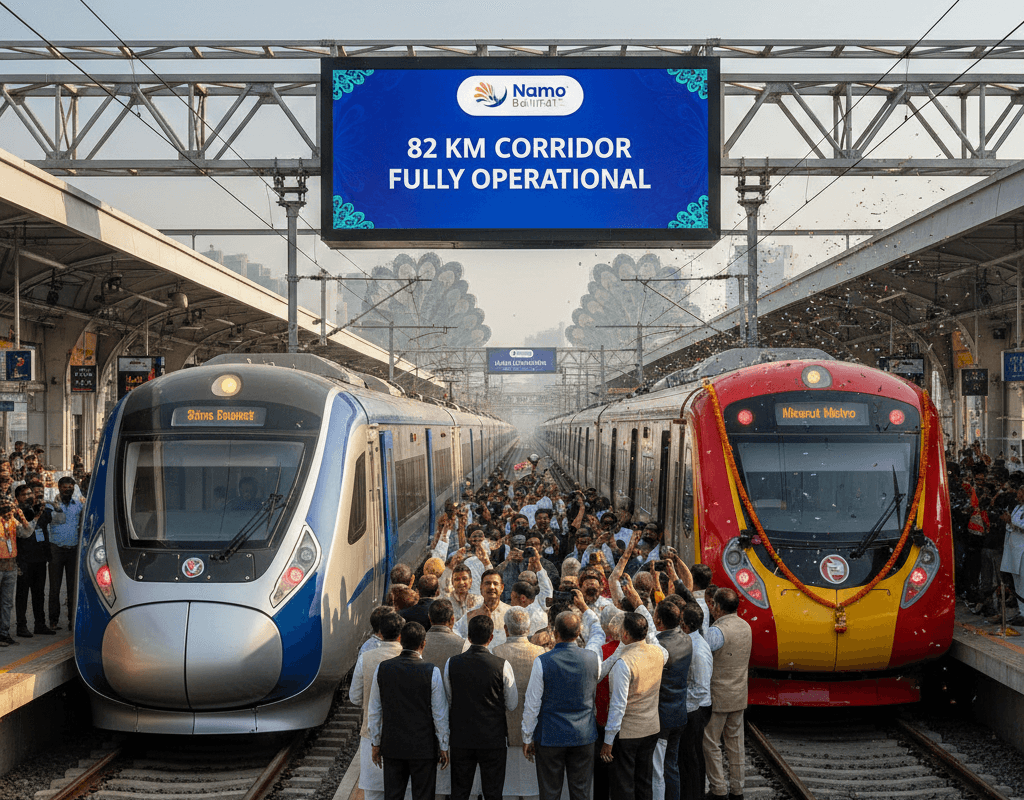
Delhi Meerut Namo Bharat Corridor Inaugurated
Delhi Meerut Namo Bharat Corridor Inaugurated
An important turning point in India’s urban transportation history has been reached with the official opening of the eagerly anticipated Delhi–Meerut Namo Bharat Corridor. The corridor, which was built as part of the ambitious Regional Rapid Transit System (RRTS) program, is intended to revolutionize connection between Delhi and Meerut by cutting travel times, clearing traffic, and bringing in a new era of fast, pleasant, and environmentally friendly transportation.
In addition to being a technological innovation, this inauguration shows the country’s dedication to constructing top-notch infrastructure that promotes regional integration, economic expansion, and environmental sustainability.
The Delhi-Meerut Namo Bharat Corridor: What Is It?
Implemented by the National Capital Region Transport Corporation (NCRTC), the Delhi–Meerut Namo Bharat line is the first Regional Rapid Transit System (RRTS) line in India. The corridor connects major cities in the National Capital Region (NCR), such as Delhi, Ghaziabad, and Meerut, and it is roughly 82 kilometers long.
The project was created as part of the Government of India’s overarching plan to improve regional mobility and lessen reliance on road transport. For everyday interstate commuters, the high-speed rail service, known as Namo Bharat, provides a semi-high-speed train experience.
A Revolution in Regional Communication
Compared to typical road trips, which frequently take two to three hours owing to traffic congestion, commuters may now travel between Delhi and Meerut in less than an hour thanks to the opening of the Delhi–Meerut Namo Bharat Corridor.
With an operational speed of up to 160 km/h, the trains can run at a design speed of 180 km/h. As a result, the corridor ranks among the nation’s quickest regional transit networks.
Principal Advantages:
- Shorter travel time between Meerut and Delhi
- Clearing traffic on roads like NH-58
- Reduced emissions of carbon
- Enhanced comfort and safety
- Encourage the growth of local businesses and real estate
Contemporary Facilities and Cutting-Edge Technology
Modern amenities and cutting-edge technology are features of the Namo Bharat trains. In addition to having comfy seats, USB connections, baggage racks, and cutting-edge safety features, the coaches have full air conditioning.
Features Focused on the Passenger:
- Automated system for collecting fares
- At certain stations, platform screen doors
- CCTV monitoring to improve security
- Committed women’s coach
- Coach in business class with first-rate seating
The new architecture of each station along the corridor ensures accessibility for both elderly and disabled passengers. Convenience and inclusivity are improved by tactile pathways, elevators, escalators, and clear signage systems.
Connectivity to Current Transportation Networks
The Delhi-Meerut Namo Bharat Corridor’s smooth interaction with various public transportation systems is one of its main features.
The hallway is connected to:
- Metro Delhi
- Railways in India
- Terminals for interstate buses
- Local city bus systems
For daily commuters, this multimodal integration guarantees more seamless last-mile connectivity and improves commute efficiency.
Effects of the Economy on the National Capital Area
It is anticipated that the corridor’s opening will boost economic expansion throughout the NCR. Businesses can extend their operations outside of Delhi with faster connection, relieving pressure on the capital and fostering growth in satellite areas like Ghaziabad and Meerut.
Financial Benefits:
- Property values near stations have increased.
- Bringing in fresh investments
- expansion of commercial and retail centers
- development of jobs during operations and construction
According to experts, the corridor would change how people commute and encourage professionals who work in Delhi to live in less expensive places like Meerut.
Benefits to the Environment and Sustainability
India’s dedication to cutting carbon emissions and advancing environmentally friendly urban transportation is supported by the Namo Bharat Corridor.
It is anticipated that the corridor will greatly lower vehicle emissions, fuel consumption, and traffic congestion by transferring commuters from private automobiles to high-speed electric trains.
Among the green features are:
- Train systems that use less energy
- Technology for regenerative braking
- Some stations have solar panels.
- Systems for collecting rainwater
This environmentally friendly strategy helps create a more sustainable urban environment and cleaner air.
Project Schedule and Phases of Development
The National Capital Region Planning framework in India served as the basis for the design of the Delhi–Meerut RRTS corridor. To guarantee on-time completion, construction started in stages.
In order to give commuters early advantages, a number of priority portions were operationalized prior to the entire opening. With the final inauguration, a significant section is finished, opening the way for full-scale operations throughout the corridor.
The project has proven India’s increasing ability to effectively complete large-scale infrastructure projects by overcoming a number of obstacles, such as land acquisition, engineering difficulties, and delays brought on by the pandemic.
Increase in Urban Growth and Real Estate
- Real estate is developing quickly in the vicinity of Namo Bharat stations. Transit hubs are seeing the emergence of mixed-use developments, residential townships, and commercial complexes.
- In order to ensure walkable neighborhoods and integrated urban planning, transit-oriented development (TOD) laws are being put into place to optimize land use surrounding stations.
- In the upcoming years, major urban development is anticipated in cities like Meerut and Ghaziabad due to increased investor confidence and improved connectivity.
The Government’s Goals for Namo Bharat
A larger national plan to update urban transportation infrastructure includes the Delhi–Meerut Namo Bharat Corridor. Similar RRTS lines linking other significant metropolitan clusters throughout India are the government’s vision.
To significantly improve regional connectivity, the NCR’s future planned corridors will connect Delhi with Panipat and Alwar.
High-speed regional transport networks across the country are anticipated to use the Delhi–Meerut corridor’s performance as a model.
Security and Safety Procedures
The Namo Bharat trains’ design and operation have placed a high premium on safety.
Superior Safety Features:
- Level 2 signaling for the European Train Control System (ETCS)
- Monitoring in real time from centralized control centers
- Systems for emergency communication
- Systems for detecting and suppressing fires
- These steps reduce operational risks and guarantee a safe travel environment.
Initial Reception and Public Reaction
The Delhi–Meerut Namo Bharat Corridor has attracted a lot of public attention since it was inaugurated. Early travelers have given high marks to the whole travel experience, cleanliness, punctuality, and smooth ride quality.
India is now among the countries with cutting-edge regional rapid transit systems thanks to the project’s excellent execution and top-notch infrastructure.
In conclusion: Delhi–Meerut Namo Bharat Corridor Inaugurated
An important milestone in India’s infrastructure development is the opening of the Delhi–Meerut Namo Bharat Corridor. The project demonstrates the country’s engineering prowess and forward-thinking urban planning by significantly cutting travel time, improving comfort, and encouraging sustainable mobility.
Such high-speed regional connection projects will be essential to guaranteeing balanced growth, lower pollution, and a better quality of life for millions of Indians as the country continues to urbanize quickly.
The Namo Bharat service is more than just a train; it represents contemporary India in motion.
Chhaava Movie Review and Box Office Collection: A Grand Success?
Chhaava Movie Review and Box Office Collection: A Grand Success?
